
Finley Students Walk Through History
A group of J. Taylor Finley Middle School students went on a fascinating historical walk this month, visiting some of the town's most legendary and even mysterious locations.
The walk took the Finley seventh grade Hawks team students down Woodhull Road and past the Kissam House Museum and the Job Sammis House, better known to locals as "The Arsenal." The group walked through the Village Green, where on the third Monday of every month the Huntington Militia still meets and drills adjacent to The Arsenal.
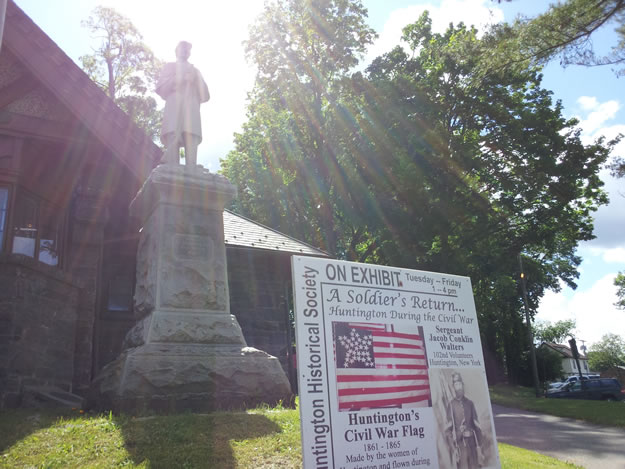
 The highlight of the field trip was a guided tour of the Soldiers and Sailors Memorial Building and the Old Burial Ground. The site is listed on the National Register of Historic Places and sits within the Old Town Hall Historic District.
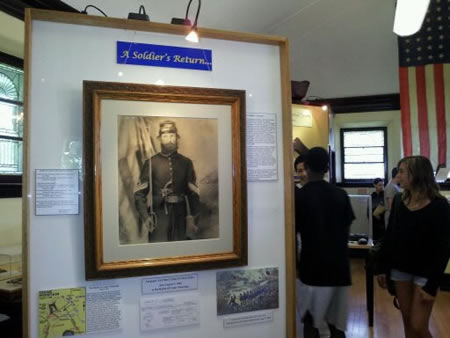
Finley seventh grade social studies teacher Esmeralda Tello organized the trip, the aim of which was to expose students to Huntington's rich history. "When I learned last year that the Huntington Historical Society had put together an exhibit called A Soldier's Return…Huntington During the Civil War, I knew I had to see it for myself," Ms. Tello said. "I was excited to meet with town historian Robert Hughes in the fall for a private tour of the collections and I looked forward to sharing my experience with my students who would be learning about the Civil War which was added to this year's seventh grade curriculum."
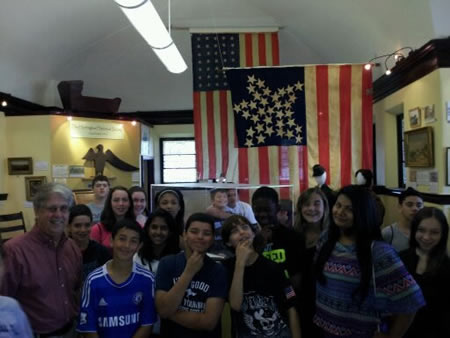
Once inside the Soldiers and Sailors Memorial Building, which was constructed in 1892 to honor the town's 40 Civil War dead, students received a presentation on Civil War era artifacts that included such items as enlistment journals, artillery, letters, uniforms, photographs and flags made by Huntington residents from 1860-1865. Robert Kissam, a Huntington Historical Society staff member and heir of the Kissam House Museum, gave a presentation centering on the special exhibit and answered student inquiries about the role that Huntington and its citizens have played through the centuries.
 Seventh grade team teachers Lauren Amendola, Tom Tantillo, Chris Theodorellis and Annette Stracuzza actively supported the historical excursion. The team took a trial walk to the village to map out the safest and most interesting route for the students. Highlights included the Vietnam cherry tree memorial on the Village Green, the Kissam House, the Old First Presbyterian First Church and The Arsenal, as the old Job Sammis house on the Village Green is known. Mr. Sammis was a weaver who hid stores of gunpowder in his attic prior to and shortly after the British occupation of Long Island and Huntington.
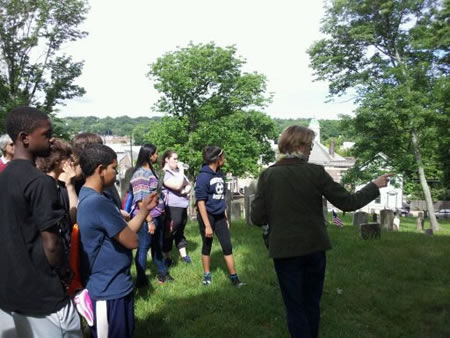
The visit to the Old Burying Ground, which contains the graves of many of the town's leading early citizens, included a guided tour by Wendy Anderson, the Huntington Historical Society's director of education.
According to historical records, during the last winter of the Revolutionary War, British troops who had occupied Huntington since September 1776, erected a fort on the top of the cemetery from timbers removed from the towns First Presbyterian Church. "Construction of the fort, known as Fort Golgotha, greatly enraged local residents and is the first recorded act of vandalism [in the town]," Ms. Tello said." At least 100 tombstones were destroyed and others were used to build bake ovens. According to local lore, bread baked in these ovens bore the reverse inscriptions of the tombstones on the lower crust."
The cemetery contains some 1,246 marked graves, although it is estimated that three to four times as many people are buried in unmarked graves, including 42 Revolutionary War soldiers, according to Ms. Tello.
 The trip culminated at Heckscher Park where students had a picnic lunch and enjoyed playing games of soccer, softball, Frisbee and making a stop at the ice cream truck.
"I am so proud of our students," Ms. Tello said. "Not only were they well behaved and responsible, but they genuinely expressed appreciation for the rich history of their town. Students asked thoughtful questions about the artifacts, the burial stones, and the manner in which free and enslaved Africans were buried in the cemetery. When it was time to leave the exhibit, students voiced their disappointment. It was then that I knew that history had really come alive for them."
"Our students who experienced this visit had revealed to them a substantial portion of the depth of Revolutionary and Civil War America that is right under the nose of any other Huntingtonian who should wish to scratch beyond the surface of our local environs," said Joseph Leavy, the Huntington School District's chairman of humanities. "Ms. Tello and the Hawks teams' planning and prioritization of this experience for their students opened the eyes of these young learners to the often unknown significant role that our Huntington played in these turning points in the history of our nation."