
Sarah Casey's Excellent Vacation

Sarah Casey doesn't like being bored, but she was just that last summer after doing the same old thing every day. So she took to the internet to do a little research and ended up in the Dominican Republic for a week during Huntington's recent spring break. It was a life-changing experience.
The Huntington High School senior spent a week building a house, plowing a field and working with impoverished children in the barrios of the countryside. She traveled with an organization that provides such opportunities for young people all across the world. Much of Ms. Casey's experiences involved learning about the concept of sustainability of the Earth and about the poverty experienced but much of the world.
"Hanging out with my friends is fun and all but as far as substance and excitement goes, I felt lame and bored," Ms. Casey recalled during a recent interview. "So my mom suggested I look up some volunteer programs so I could travel and meet some cool people. "At first I was put off by the idea because I didn't want to spend my summer or any vacation working. The more I read about it and researched organizations like Global Leadership Adventures and Cross Cultural Solutions, I realized that the adventures that places like Russia, India, Africa, and South America could offer beat any week of partying in Huntington."
 Ms. Casey eventually found a trip to the Dominican Republican sponsored by Global Leadership Adventures "and thought it was perfect," she said. "I wrote an essay to the organization and got into the one week program in Puerto Plata!"
The senior is headed to Pace University in the fall to study business. She is interested in starting her own company. "Before the trip I was very focused on a business career and making a lot of money, but now I think I want to change the way businesses are run - green technology sort of stuff and a focus in sustainable living."
Very Nervous to Leave
When it finally came time to leave on the journey, the teenager admits she was "very nervous" since she "had not signed up with any of my friends and I was going to go away for a week with complete strangers," she said. "The plane ride was nerve-racking but when we landed I saw another girl, Jessica who looked just as nervous wearing a GLA t-shirt. We talked for a while and I learned she was from the state of Washington and we mocked each other's accents. About 20 other American tourists came out of the airport looking for shuttle buses to resorts wearing huge sunglasses and brushing by the Dominican people."
During those first moments in a strange land Ms. Casey and her newfound friend, Jessica waited at the airport to be picked up by a man named Dave, the director of trip. "Alone at a Dominican airport, I learned that being blonde is not common in some parts of the world," Ms. Casey said. "Dave got us along with five other girls from California and England. We drove excited to where we would be living for the next week."
Ms. Casey's new home was a heavily gated beach property with five identical houses each able to hold up to a dozen people. The GLA group numbered 40 girls and only four boys.
Making Friends Isn't Scary
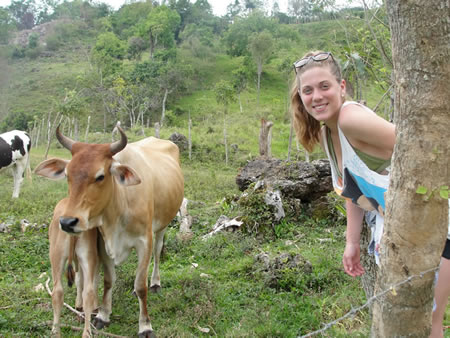 "The first thing I learned in Puerto Plata is that making friends is not as scary as I had anticipated," Ms. Casey said. She found everyone "in the same boat and looking for someone to hang out with. I instantly found my three best friends for the week and we shared stories about our hometowns and our thoughts of the trip. Dinner was chicken rice and beans, a traditional Dominican meal that I would grow very accustomed to."
On her first full day in the Dominican Republic, Ms. Casey was out of bed at 6 a.m. and ready to leave for work an hour later. "The funny thing about waking up early is that it is much easier when you have a beautiful beach sunrise to watch," she joked. "We loaded onto buses all dressed in sneakers and workout outfits, having no clue where we were headed. Arriving at El Barrio, the town in which a family's house had been collapsing was surreal. It was nothing like America where streets are paved, houses are furnished, power lines are organized, or clothing and booze are widely used responsibly. I got my first glimpse into a Third World country and I was shocked.
As the group walked up a street that ran off in a series of different directions, they passed more collapsing shacks and small structures that sell basic goods like soda, cookies, bread, milk, butter, eggs, chicken, rice, beans.
"The house that we were to fix up was a 14 by 20 foot shack holding 12 people, maybe 7 feet high and covered in hot tin," Ms. Casey said. "The people are beautiful and happy and will do anything for you. They are all smiles and all of them help. No one knows English, so knowing Spanish is extremely important, especially when you're knee deep in rusty old tin and need a hammer!"
Ms. Casey admits that her Spanish was "rusty" but said it was transformed into a "fluid scramble of sentences that the natives seemed to understand," even if many words were mispronounced, if not completely wrong.
"It felt really good to be able to communicate with people, in their own language, and understand them," the teenager said. "I glanced to my left and saw a chicken next to my leg, something very different from what I'm used to. A half hour later, I couldn't find that chicken anywhere, but I was handed lunch - a plate of rice, beans and chicken. It was the most delicious food I have ever eaten and there was so much fresh fruit!"
Immersed in the Culture
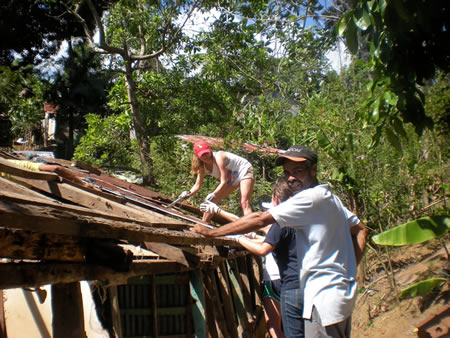 Instead of hanging out at a friend's house, the movie theatre on Wall Street in Huntington village or just sleeping late, Ms. Casey found herself giving out English flash cards and books to the children she encountered at the house she was helping to reconstruct. "But, I later saw that many of the mothers were trying to read the books and play flash cards with each other," she said. "Seeing these 18 year old mothers of three, I really thought about where I am in life, compared to them; same age, same world, but vastly different opportunities. Many of these young women were mothers at 16, cannot read, know nothing of the world, but are happy!"
During those hours Ms. Casey's thoughts drifted off to "all of my so-called 'problems,'" she recalled. "Real life seems to me, now, a connection with nature, survival and family," she said. "It is not Facebook relationships, making money to afford a mansion, getting the cutest new shoes. These things only seem to distract us from any true connection with nature and ourselves. The time at El Barrio helped me understand what is truly important and to be grateful for the life of opportunity that I have."
Following two days in El Barrio, the group hiked six miles up Brisson Mountain to have lunch with a farm family. "We started the hike with a young pregnant woman," Ms. Casey said. "She beat us up the steep slope in no time, wearing no shoes! We were the epitome of lazy Americans! There were so many complaints on the hike from pampered girls who didn't want to work. The view at the top was beautiful! So simple with cows roaming around, no buildings, factories, stores, or extravagant built-in swimming pools. Real beauty, real food, real people."
Eye-Opening Experience
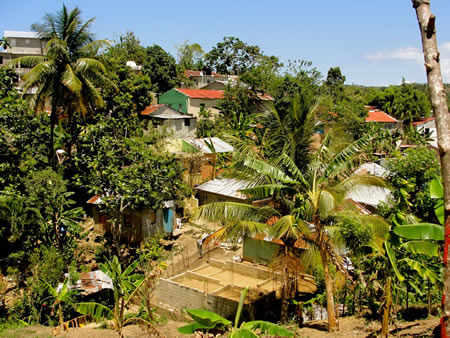 It was an eye-opening experience for the Huntington senior. "At Brisson, I would have given up everything I have to set up camp and live on a secluded mountain for the rest of my life," she said. "They were happy and simple people. It makes me wonder about our lives in America and how obsessed we are with keeping up with this idea of wealth. 'Things,' status, clothes, shoes, job title, really means nothing to people who only worry about food, shelter and survival. I think I would rather live for myself than spending my whole life trying to be better than others and have more than them."
Evening hours during the weeklong trip included a review of what the group learned each day. The traveling party watched documentaries, ate dinner and "passed out by nine, all tired from a day of hard work and culture shock, Ms. Casey said. "I feel I made really deep connections with people on this trip because we all shared something important. We were changed together and got to talk about it in a real way. There was no partying or getting crazy to have fun. We played games like tag and slaps. Like little kids, we just had fun."
The fourth and fifth days of the trip "were the most surreal," Ms. Casey said. "In the Dominican Republic there are many Haitians who have lived there for many years and are no longer considered Haitian citizens. The Dominicans refuse to grant them citizenship because of ancient animosity, so the people are forced to live in projects deep in sugar cane fields. Our job was to help the people create a sustainable garden so they could rely on themselves for food."
When the group's bus pulled up to the area, they were told to roll up the windows so nothing would get stolen. "The people bombarded us, looking hungry and tired from heat," Ms. Casey said. "They begged us to buy jewelry and give them water. It was hard to say no but I didn't have money to help everyone. One girl I will never forget latched onto me the second I got there and didn't let go until the final day. Raphaela helped me to carry loads of debris to the dump and never said a word. I tried to talk to her but she squeezed my arm so tight and just looked scared."
Ms. Casey and members of her group cleared a plot of land and made it farmable. Dave, the group leader, explained to the teenagers that he wanted to give the people there an opportunity to rely on themselves for food instead of being reliant on Dominican imports.
Community of Lost Souls
"The final day in the projects, a woman and a man had gotten into a fight and the man was beating her in the street," Ms. Casey recalled. "We were rushed onto the bus and left these people to their culture, hoping the best for them. The bus ride was silent and we all knew that we had seen a community of lost souls, out of place with no help."
The Huntington senior admits her spring break was unlike that of her classmates. "I did not party every night, relax or even make money," she said. "My two plane rides could not have been more different. Going to the Dominican Republic, I was excited to meet people, hang on the beach, buy some jewelry and see poverty. On the plane ride home I was exhausted from so much manual labor I'm not used to, angry that I couldn't help those people more, sick from the airline's processed food I had not eaten all week and helpless because I was going back to a world that I didn't really want to be a part of anymore."
Looking back over her journey and the experiences she gain, Ms. Casey has some strong opinions. "I would suggest a trip like this to everyone," she said. "At least once in your life, see what you're missing. People are happier without the materialistic obsessions that we seem to live by. Life is about connection with yourself and nature. That doesn't mean your Facebook page and how many people look at it. The American way of life and our capitalistic culture is great but it's important to remind yourself every once in a while that life is much more than surface."