Lower East Side Tenement Museum Comes to Finley
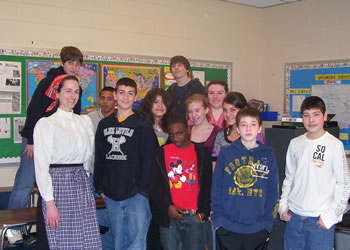 The immigrant experience was brought to life for eighth graders at J. Taylor Middle School when Lower East Side Tenement Museum historian-actress Lily Paulina visited classes and discussed what it was like to be a newcomer to New York City during the early 1900s.
Ms. Paulina’s presentation, which was sponsored by the Huntington School District’s arts-in-education program, was interactive in nature, with all students expected to participate. Class members were asked to imagine it was 1916, that they were immigrants “fresh off the boat,” and were just making their way through Ellis Island. From there they were greeted by Ms. Paulina’s character, “Victoria Confino,” a recent immigrant from Kastoria in the old Ottoman Empire.
Victoria Confino was a real immigrant who came to the United States with her mother and siblings in 1913. Her father and brother were already settled on the Lower East Side of Manhattan at 97 Orchard Street, where the Tenement Museum is located today.
The students asked a variety of questions about what to expect from their new lives in America and they used Victoria as their guide. They asked about her personal background (family, religious and life in Kastoria) and questions that would help them feel more comfortable in America (housing, jobs, education, healthcare, community, religion and how to better assimilate into American culture).
Victoria also brought a suitcase filled with “artifacts” that the students were able to examine and learn more about. Victoria showed actual photos of her family and her home in Kastoria as well as an eye hook used at Ellis Island, newspapers written in Hebrew, a school textbook, and other household items like a real iron used for “smashing your wrinkles.”
When the presentation began, students appeared awkward and uncomfortable with Victoria, but within minutes questions started flowing one after another. Students took on their role with confidence and they enjoyed the back and forth conversation with Victoria.
“The students truly connected with Victoria Confino and the presentation,” Finley English teacher Kim Schiller said. “They have learned so much in their social studies classes that it really brought the chapter to life. The students were very intrigued by her accent and they learned a great deal of what it was like to be a new immigrant in America.”
The presentation and information fascinated classes. “The students also made a connection to our English class and the novel we are currently reading, Ashes of Roses,” Ms. Schiller said. “The novel is about an Irish family who has big dreams before coming to America. Then just after they arrive at Ellis Island heartbreak and reality begin to set in when the infant son, Joseph, has trachoma and must be sent home. For the remainder of the novel the two daughters, Rose and Maureen Nolan, try to transition smoothly into America, but find it difficult to do so.”
The AIE program works with teachers and administrators to bring meaningful programs tied to the academic curriculum into each of the eight district buildings. “One thing I learned was that immigrants were discriminated against and it was very hard for immigrants coming to America,” student Alex Mannheimer said. “I hope I can go to the Lower East Side Tenement Museum when I have enough time to learn more about their experiences.”
Director of Humanities Joseph Leavy said he’s happy to have Ms. Schiller’s initiative and ideas and grateful for the help and planning provided by arts coordinator Marcy Rhodes and the AIE program in bringing the Tenement Museum presentation to Finley. “The eighth graders were immersed in a dramatization of a visiting immigrant at the turn of the century, thus fully connecting a simulated role play with their English literature study and social studies curriculum in evaluating the Gilded Age," Mr. Leavy said.
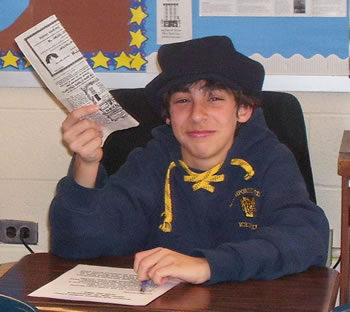 “It really felt like we were in 1916,” student Lauren Boyce said. “I enjoyed all the pictures she showed us. I loved all the artifacts too, especially the button hook they used on Ellis Island and the school book. One of my favorite parts was when you told the story about your little brother using crates as a bed. I learned a lot that I will remember.”
The program really captured the attention of students. “I learned a lot from this experience,” student Kristina Casale said. “I loved looking at the eye hook. This really helped me get a better idea of what it was like for immigrants coming into America. It was really interesting for me to connect the book, Ashes of Roses, with your presentation. I felt like I was actually there, and I couldn’t tell if the accent was fake or not!”
“It was an amazing experience and it really helped me understand what I’ve been learning about in class a lot more,” student Michael Lambui said. “I am very proud to have had Lily Paulina back for a second year and hope to continue this tradition next year as well,” Ms. Schiller added. “It was a worthwhile and eye-opening experience for everyone.”
For more information about the Lower East Side Tenement Museum visit http://www.tenement.org/.
All graphics, photographs, and text appearing on the Huntington Public Schools home page and subsequent official web pages are protected by copyright. Redistribution or commercial use is prohibited without express written permission. Comments or Questions? email the Public Information Office