Huntington Alum Meets President of African Country
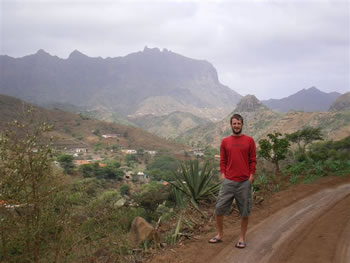 Scott Jeno was going about his usual business as a Peace Corps volunteer in the Cape Verde Islands, 310 miles off the west coast of Africa in the North Atlantic. The 2002 Huntington High School graduate was at a conference in the city of Assomada, preparing for summer training of the next group of volunteers, when all of a sudden he received word to quickly prepare to travel to the president’s house for a diplomatic reception.
In the midst of 27 months of volunteer service with the Peace Corps, Mr. Jeno began his stint in Cape Verde on Sept. 1, 2007. He has been teaching seventh and eight graders English in the village of Sao Francisco. The Peace Corps built him a small concrete house since it’s the first time it has ever had one of its volunteers in this particular village. He also teaches adults from Sambala village six nights a week. That village is a developing resort area and he serves as a link between the village and the community.
The spur of the moment invitation to President Pedro Verona Pires home was a welcome surprise. Mr. Pires presented outgoing American Ambassador Roger D. Pierce with Cape Verde’s highest Foreign Service award. Mr. Jeno and two other volunteers were chosen to help represent the Peace Corps at the reception.
“I was pulled out of my training session, borrowed a shirt and tie from the volunteer in Assomada, grabbed a jacket and shoes from the Peace Corps director and was on my way, unshaved and unshowered,” Mr. Jeno recounted. “Anyway it was very nice. There were about 40 people there. All the ambassadors in Cape Verde were there. The [American] ambassador stood with the president and gave a little speech where about a third of it was about the Peace Corps. The president gave him an award and then we had cocktails and hors d’oeuvres.”
 Cape Verde is a nation comprised of ten volcanic islands, about 450 miles north/northwest of Senegal. The population of about 507,000 is 76 percent literate. The country has a republic form of government and is a stable democracy. The population is a mix of African and European descent. Although water shortages have hurt agriculture, tourism is a growing industry. The nation has been independent since 1975.
“The minister of foreign affairs was really awesome,” Mr. Jeno said. “He came up and asked if I want to speak Creole (badiu) or Portuguese, which I thought was a warm gesture. So I replied 'klaru badiu' (of course, badiu). So we were talking in Creole about my job and stuff and how he wants his English to improve.”
Mr. Jeno earned a Bachelor of Arts degree in history education at C.W. Post College in 2006. He toyed with the idea of teaching social studies on Long Island, before deciding to join the Peace Corps. He probably never imagined he would one day meet the leaders of an African nation.
“I saw and talked to some familiar faces in the embassy and some agencies congratulated the ambassador and his wife, joked around a little with him,” Mr. Jeno said. “Then I went and gave my regards to the president. My Creole is by far much better than my Portuguese and I get a kick out of the Creole greetings so I introduced him in the local Creole greetings, 'kampeon? situason?' (Are you champion? How’s your situation?) The presidents face lit up and he laughed and said 'ah el sta kriolu! prazer' (ah he's Creole! pleasure). I saw my opportunity and took it. All in all it was a nice little gathering.”
All graphics, photographs, and text appearing on the Huntington Public Schools home page and subsequent official web pages are protected by copyright. Redistribution or commercial use is prohibited without express written permission. Comments or Questions? email the Public Information Office