An Immigrant’s Experience at Finley
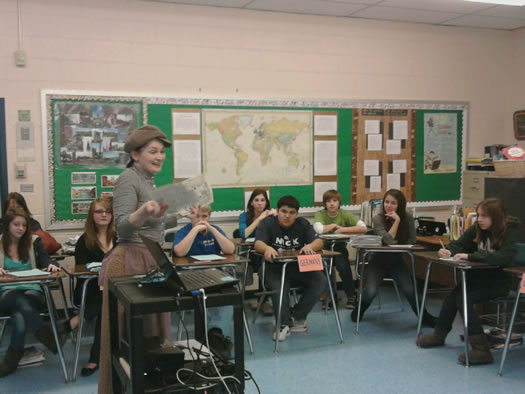
The Lower East Side Tenement Museum visited J. Taylor Finley Middle School last week for three days of interactive classroom presentations. It marked the fourth year the organization has been invited to work with eighth graders in an arts-in-education sponsored program that encompasses English, social studies and even a little bit of math.
“A Visit from Victoria Confino,” provided Finley students with an opportunity to meet a 16-year old girl from Kastoria, Turkey who arrived with her family at Ellis Island in 1912. They made their living making aprons in a family-owned business. The Confino’s struggled, but since their arrival from Kastoria, they continued to persevere, even if it meant taking Victoria out of school to help the family. The young girl completed only two years of school then went to work to help support her family.
The extended family of ten, which included cousins, resided in a tenement at 97 Orchard Street, where the Lower East Side Tenement Museum stands today. Victoria and her family had to escape Kastoria during the Balkan War. Their home was destroyed and they escaped to America before anyone could be harmed.
During the visit to Finley, “Victoria” explained to students that she loves America, but still misses her home country. “We also learned that she never made it back to her home country because she knew there was nothing left for them,” said Kimberly Schiller, a Finley social studies teacher who helped coordinate the visit.
“The program is so worthwhile,” Ms. Schiller said. “It connects exactly to what the students are learning and makes this part of our history relatable and real. When ‘Victoria’ entered my classroom, my students were taken aback at first. They weren’t sure what to think, but quickly became comfortable and asked ‘Victoria’ many questions.”
Students were well-prepared for the presentations. “Before her visit, I instructed the students that they were no longer living in 2010, but instead in 1916,” Ms. Schiller said. “I also set them up in families/cooperative-learning groups from around the world to help them fit this role.”
The “families” included immigrant ones from Austria, Germany, Sweden, Sicily, Palestine, Greece and Syria. “I also try to do things as authentically as possible,” Ms. Schiller said. “For example, when I set the students up in their families, I used real immigrants who came through Ellis Island and the students read their stories with their family. They also examined boarding passes with their subject’s name, home country, occupation and education, age, reason for leaving, etc., just as a real boarding pass would have.”
It was a thoroughly enjoyable and enlightening experience for the Finley eighth graders. “Today, the students had a great time,” Ms. Schiller said. “They kept the authenticity, but still had fun with it. Some even tried their own European accent to fit in more with the presentation. At one point, a student in class asked ‘Victoria’ what they could do to fit in here. ‘Victoria’ laughed and explained that the young ladies would not find husbands while they are dressed as boys (because of their pants, 2010 clothing, etc.) and the young men in class dressed like ‘grandfathers’ because they were not wearing knickerbockers.”
The educator from the Lower East Side Tenement Museum also discussed what was “in” during her time, including the nickelodeon (small neighborhood movie theatres), actor Charlie Chaplin, the foxtrot dance and more serious topics such as work, education, living conditions, prejudices, and how she and her family assimilated into America.
“However, throughout the program, the only way it could be successful is for the students to push the conversation and they really did that,” Ms. Schiller said. “I was so proud of their questions and the way they handled themselves.”
The Finley students rattled off questions such as Do you regret coming to America? Do you miss your home in Kastoria? How is it different from New York? Do people look at you differently because of your race? Did you disagree with your family for wanting to come here? Are you trying to become more American since arriving here? “All wonderful and pertinent questions,” Ms. Schiller said. “They helped the students have a better idea of what life was like for an immigrant. Many even connected these issues with today’s immigrants and what their struggles are.”
All graphics, photographs, and text appearing on the Huntington Public Schools home page and subsequent official web pages are protected by copyright. Redistribution or commercial use is prohibited without express written permission. Comments or Questions? email the Public Information Office